Elliptic: North Korean crypto laundering routes record-setting $6,400,000,000 Binance haul through 12,000 wallets across 11 chains
North Korean crypto laundering follows $6.4 billion Binance heist
Following last week’s record-setting $6.4 billion Binance heist, North Korean hackers have been moving the stolen cryptocurrency into a new wallet roughly every 25 seconds, according to blockchain analytics company Elliptic.
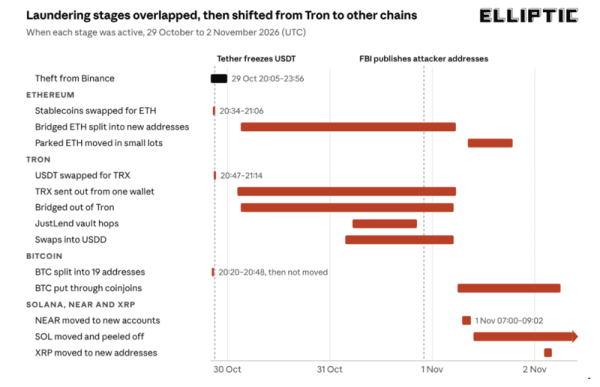
In a fresh analysis, Elliptic says the sophisticated operation shows clear signs of automation. In under four days, it involved 40,000 transactions, 12,000 wallets and 11 separate blockchains.
Tron has handled most of the laundering so far, with the funds divided among approximately 7,700 addresses before being bridged to Ethereum.
ETH, SOL, NEAR, and XRP have started moving since November 1. Some of the stolen assets have now been mixed for the first time. Since that date, roughly 28 BTC ($2.2 million) has passed through Wasabi-style coinjoins.”
Tom Robinson, Elliptic’s co-founder and chief scientist, says the hack yielded $3.46 billion in cryptocurrency, including stablecoins such as USDT and USDC that their issuers can freeze. This movement adds to the picture of North Korean crypto laundering.
That made converting the stablecoins into assets such as Ethereum (ETH) and Tron (TRX) the hacker’s immediate priority. North Korean crypto laundering relied on moving the funds quickly.
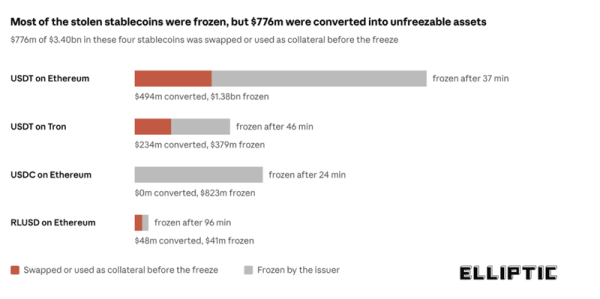
“Tether blocked the stolen USDT on Ethereum 37 minutes after the funds arrived. In that brief window, the attacker exchanged 434 million USDT for ETH through decentralized exchanges (DEXs), including Uniswap. The hacker also used another 59.9 million USDT as collateral to borrow 19,762 ETH on Aave. On Tron, 234 million USDT was converted into TRX through SunSwap before Tether could lock the remaining funds. Circle stopped all 823 million stolen USDC before any exchanges took place.
Altogether, authorities have frozen or seized $2.85 billion.
Roughly $786 million in stablecoins had been converted before the freezes took effect.”
Chainalysis says the record-setting hack was carried out by TraderTraitor, a North Korean cybercrime group believed to work under the state-backed Lazarus Group, known for North Korean crypto laundering.